


Five miniatures
Oddtown
Odd distances
Triangle regions
Rounding trouble
Equiangular lines
Oddtown
Oddtown has $n$ residents
- Every club must have an odd number of members
- Any two clubs must have an even number of common members
What is the maximum number of clubs?

| Resident 1 | Resident 2 | Resident 3 | |
| Club 1 | 1 | 1 | 0 |
| Club 2 | 1 | 1 | 1 |
| Club 3 | 0 | 1 | 1 |
$A$$A^T$$ = \begin{bmatrix} - & \mathbf{a_1} & - \\ - & \mathbf{a_2} & - \\ & \vdots & \\ - & \mathbf{a_m} & - \end{bmatrix}$$\begin{bmatrix} | & | & & | \\ \mathbf{a_1} & \mathbf{a_2} & \dots & \mathbf{a_m} \\ | & | & & | \end{bmatrix}$
$$= \begin{bmatrix}|C_1| & |C_1 \cap C_2| & \dots & |C_1 \cap C_m| \\ |C_2 \cap C_1| & |C_2| & \dots & |C_2 \cap C_m| \\ \vdots & \vdots & \ddots & \vdots \\ |C_m \cap C_1| & |C_m \cap C_2| & \dots & |C_m| \end{bmatrix}$$
$$M := AA^T \equiv \begin{bmatrix}1 & & & \\ & 1 & & \\ & & \ddots & \\ & & & 1\end{bmatrix}$$
$\det(M) \equiv 1$
$m =$ $\mathrm{rank}(M)$ $\le$ $\mathrm{rank}(A)$ $ \le n$

Even Town has $n$ residents
- Every club must have an even number of members
- Any two clubs must have an even number of common members
What is the maximum number of distinct clubs?
Five miniatures
Oddtown
Odd distances
Triangle regions
Rounding trouble
Equiangular lines
Odd distances
Can the plane contain three points whose pairwise distances are all odd?
Can the plane contain four points whose pairwise distances are all odd?
Suppose such four points exist: $(0,0) = $ $\mathbf{p_0}, \mathbf{p_1}, \mathbf{p_2}, \mathbf{p_3} \in \mathbb{R}^2$
$A$$A^T$$ = \begin{bmatrix} - & \mathbf{p_1} & - \\ - & \mathbf{p_2} & - \\ - & \mathbf{p_3} & - \end{bmatrix}$$\begin{bmatrix} | & | & | \\ \mathbf{p_1} & \mathbf{p_2} & \mathbf{p_3} \\ | & | & | \end{bmatrix}$
$$= \begin{bmatrix}\mathbf{p_1} \cdot \mathbf{p_1} & \mathbf{p_1}\cdot\mathbf{p_2} & \mathbf{p_1}\cdot\mathbf{p_3} \\ \mathbf{p_2}\cdot\mathbf{p_1} & \mathbf{p_2}\cdot\mathbf{p_2} & \mathbf{p_2}\cdot\mathbf{p_3} \\ \mathbf{p_3}\cdot\mathbf{p_1} & \mathbf{p_3}\cdot\mathbf{p_2} & \mathbf{p_3}\cdot\mathbf{p_3} \end{bmatrix}$$
$$|\mathbf{p_1} - \mathbf{p_2}|^2 = |\mathbf{p_1}|^2 + |\mathbf{p_2}|^2 - 2\mathbf{p_1}\cdot\mathbf{p_2}$$
$$2\mathbf{p_1}\cdot\mathbf{p_2} \equiv 1$$
$M := 2AA^T \equiv \begin{bmatrix}0 & 1 & 1 \\ 1 & 0 & 1 \\ 1 & 1 & 0 \end{bmatrix}$$\implies \det(M) \equiv 0$
What now?
$$2AA^T = \begin{bmatrix}2\mathbf{p_1} \cdot \mathbf{p_1} & 2\mathbf{p_1}\cdot\mathbf{p_2} & 2\mathbf{p_1}\cdot\mathbf{p_3} \\ 2\mathbf{p_2}\cdot\mathbf{p_1} & 2\mathbf{p_2}\cdot\mathbf{p_2} & 2\mathbf{p_2}\cdot\mathbf{p_3} \\ 2\mathbf{p_3}\cdot\mathbf{p_1} & 2\mathbf{p_3}\cdot\mathbf{p_2} & 2\mathbf{p_3}\cdot\mathbf{p_3} \end{bmatrix}$$
$\mathbf{p_1} \cdot \mathbf{p_1} =$ square of an odd number $\equiv 1 \pmod{8}$
$2\mathbf{p_1} \cdot \mathbf{p_2} = |\mathbf{p_1}|^2 + |\mathbf{p_2}|^2 - |\mathbf{p_1} - \mathbf{p_2}|^2$ $\equiv 1 \pmod{8}$
$$2AA^T \equiv \begin{bmatrix}2 & 1 & 1 \\ 1 & 2 & 1 \\ 1 & 1 & 2 \end{bmatrix}$$
$$\implies \det(2AA^T) \equiv 4 \pmod{8}$$
$3 =$ $\mathrm{rank}(M)$ $\le$ $\mathrm{rank}(A)$ $ \le 2$
Problem
What is the maximum number of points in space whose pairwise distances are all odd?
Five miniatures
Oddtown
Odd distances
Triangle regions
Rounding trouble
Equiangular lines
Triangle regions
$n$ lines in the plane (no three concurrent, no two parallel)

How many triangular regions must there be? At least $n-2$?
Observation: if we move the lines slightly, the regions barely change
Fix two lines. Can we translate the other $n-2$ lines
while preserving all triangular regions?


Preserving triangular regions $\Leftrightarrow$ the line velocities satisfy linear constraints
Proof by contradiction: suppose there are $< n-2$ triangular regions
Number of constraints $<$ number of unknowns (velocities)
$\implies$ there is a nonzero solution, so the lines can move at constant velocity!
The first moment when three lines become concurrent?
Before the first triple intersection, every region is essentially unchanged
But just before that moment...

Five miniatures
Oddtown
Odd distances
Triangle regions
Rounding trouble
Equiangular lines
Rounding trouble
An online shop is processing orders.
Suddenly all coins worth less than one dollar are abolished!
How should the shop round each item price
so that every order total changes only a little?
Suppose the items are $1, 2, \dots, n$, and the fractional part of item $i$ is $c_i$
Orders $S_1, \dots, S_m \subset \{1, 2, \dots, n\}$
Beck-Fiala theorem
If each $i$ appears in at most $d$ sets $S_k$,
then there are $z_1, \dots, z_n \in \{0,1\}$
such that $\left|\sum_{i \in S_k} z_i - \sum_{i \in S_k}c_i\right| < d$ for every $S_k$.
Let the prices move?
$c_i \in (0,1) \to x_i \in [0,1] \to z_i \in \{0,1\}$
Rule: once $x_i$ reaches 0 or 1, it stays fixed
Before it is fixed, we say $x_i$ is floating
While prices are floating, which $S_k$ should worry us?
Call an order dangerous if it contains more than $d$ floating items
Fewer and fewer items float, so fewer and fewer orders are dangerous
How can prices move while every dangerous order total stays fixed?
Dangerous orders $\Leftrightarrow$ linear constraints on the floating prices $x_i$
Number of constraints $<$ number of floating prices?
Nonzero solution $\implies$ floating prices can move at constant velocity
until some floating price first reaches 0 or 1
After an order stops being dangerous,
its at most $d$ floating items can change the total by $< d$.
Discrepancy theory
$S_1, \dots, S_m \subset \{1,2,\dots, n\}$
Given a coloring $f\colon \{1,2,\dots, n\} \to \{-1, 1\}$
Score it by $\chi(f) = \max_k |\sum_{i\in S_k}f(i)|$
If each $i$ appears in at most $d$ sets $S_k$,
how large can $\min_f\chi(f)$ be?
| 1981 | Beck–Fiala | $2d-2$ |
| 1997 | Bednarchak–Helm | $2d-3$ |
| 2017 | Bukh | $2d-\log^* d$ |
| Conjecture | $O(\sqrt{d})$ |
Five miniatures
Oddtown
Odd distances
Triangle regions
Rounding trouble
Equiangular lines
Equiangular lines
How many lines can we place in the plane so that all pairwise angles are equal?
How many equiangular lines can we place in space?
3 lines? 4 lines? 6 lines?
Choose unit column vectors $v_1, \dots, v_n \in \mathbb{R}^3$ on the equiangular lines
$v_iv_i^T$ is a 3 x 3 symmetric matrix
What is the dimension of the space of 3 x 3 symmetric matrices? 6!
Are the symmetric matrices $v_1v_1^T, \dots, v_nv_n^T$ linearly independent?
Suppose $a_1v_1v_1^T + \dots + a_nv_nv_n^T = 0$
$\implies v_1^T(a_1v_1v_1^T + \dots + a_nv_nv_n^T)v_1 = 0$
$\implies a_1 + a_2 \alpha^2 + \dots + a_n \alpha^2 = 0$
$\implies (1-\alpha^2)a_1 + \alpha^2(a_1 + \dots + a_n) = 0$
$\implies \dots \implies a_1 = \dots = a_n = 0$
The equiangular lines problem
In $d$ dimensions, let $N_\alpha(d)$ be the maximum number of equiangular lines with angle $\arccos\alpha$
| 1973 | Neumann | $N_\alpha(d) \le 2d$ unless $1/\alpha$ is an odd integer |
| 1973 | Lemmens–Seidel | $N_{1/3}(d) \approx 2d$ |
| 1989 | Neumaier | $N_{1/5}(d) \approx 3d/2$ |
| 2016 | Bukh | $N_\alpha(d) \le 2^{c/\alpha^2}d$ |
| 2018 | Balla–Dräxler– Keevash–Sudakov | $N_\alpha(d) \lesssim 1.93d$ when $\alpha\neq 1/3$ |
| 2020 | J.–Polyanskii | $N_\alpha(d) \approx c_\alpha d$ when $\alpha \ge 1/(1+2\sqrt{2+\sqrt{5}})$ $N_{1/(1+2\sqrt{2})}(d) \approx 3d/2$ |
| $N_\alpha(d) \lesssim 1.49d$ when $\alpha\neq 1/3, 1/5, 1/(1+2\sqrt{2})$ | ||
| Conjecture | $N_{1/(2k-1)}(d) \approx \frac{k}{k-1}d$ In particular, $N_{1/7}(d) \approx 4d/3$ |
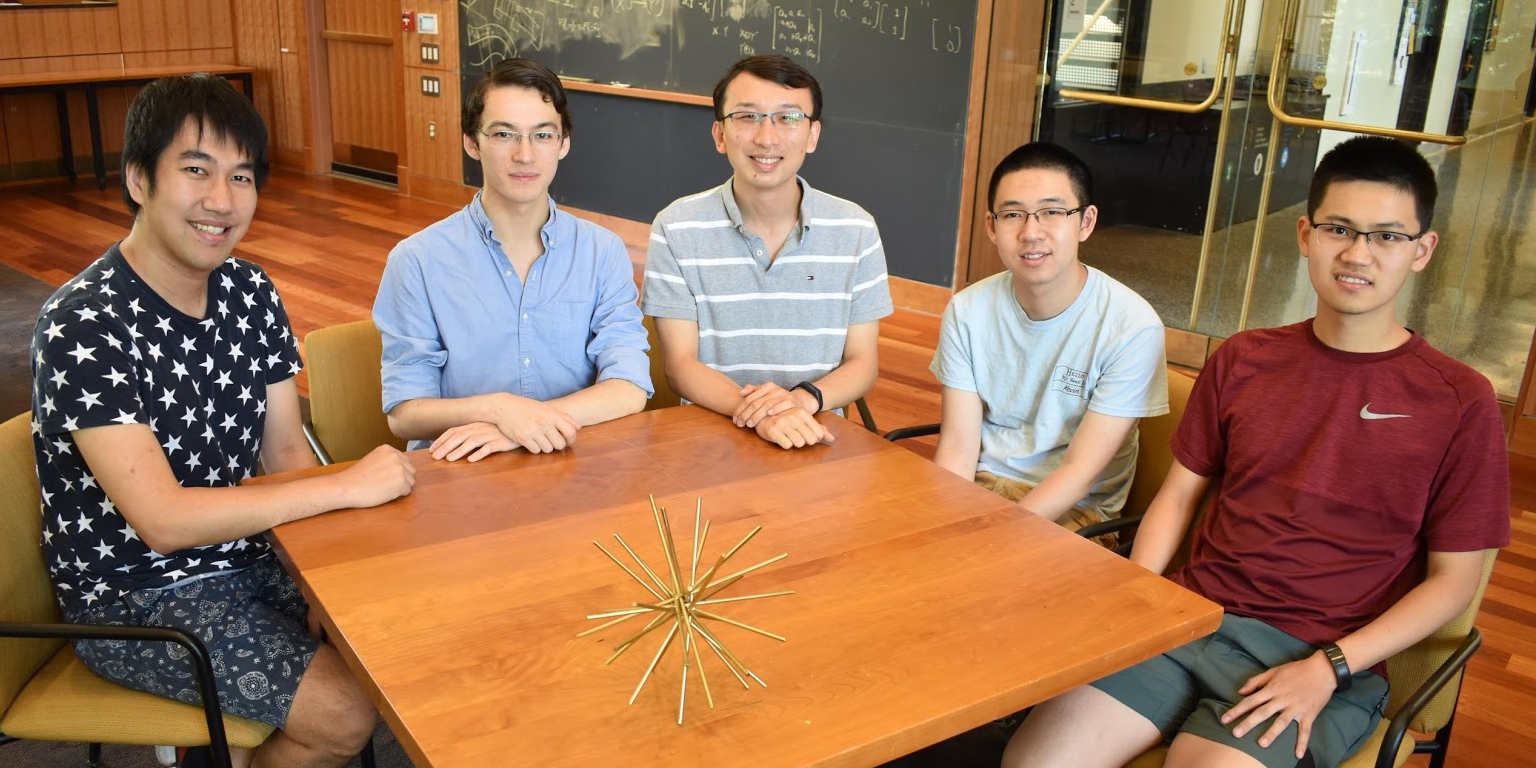
J., Tidor, Yao, Zhang, Zhao 2021 Annals of Mathematics
$N_\alpha(d) = \left\lfloor \frac{k}{k-1}(d-1) \right\rfloor$ for $d \ge d_0(\alpha)$ if $k(\lambda) < \infty$;
$N_\alpha(d) = d+o(d)$ otherwise,
where $\lambda = \frac{1-\alpha}{2\alpha}$ and $k(\lambda)$ is the smallest integer $k$ such that
there exists a $k$-vertex graph whose adjacency matrix has spectral radius $\lambda$.

Arizona State University
[email protected]