


Median eigenvalues of subcubic graphs
Subcubic graphs
maximum degree at most 3
Eigenvalues of adjacency matrix
$\lambda_1 \ge \dots \ge \lambda_n$
Median eigenvalues
$\lambda_h = \lambda_{\lfloor (n+1)/2 \rfloor}, \lambda_l = \lambda_{\lceil (n+1)/2 \rceil}$
Hückel Model Theory
| Chemistry | Mathematics |
|---|---|
| Organic molecules | Chemical graphs (connected + subcubic) |
| $\pi$-electron energy levels | Eigenvalues |
| Highest occupied molecular orbital energy | $\lambda_h$ |
| Lowest unoccupied molecular orbital energy | $\lambda_l$ |
| Kinetic stability | $\lambda_h - \lambda_l$ |
Fowler & Pisanski 2010
Computations Most chemical graphs have
median eigenvalues in $[-1,1]$, with single exception
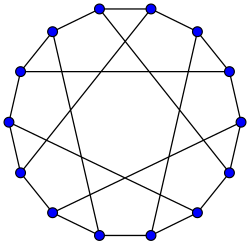
Eigenvalues $-3, (-\sqrt2)^6, (\sqrt2)^6, 3$
Conjecture Median eigenvalues of all but finite chemical graphs are in $[-1,1]$
Optimality
Guo & Mohar constructed infinitely many bipartite chemical graphs with median eigenvalues $\pm 1$
Fowler & Pisanski 2010 Subcubic trees
Mohar 2013 Planar bipartite chemical graphs
Mohar 2016 Bipartite chemical graphs except Heawood
Several other supplementary results
Acharya, Jeter, J., 2025
All chemical graphs except Heawood
Proof
- 1% of proof for 99% of cases
- 99% of proof for 1% of cases
For simplicity, only focus on $\lambda_h \le 1$
Proof for 99%
Take maximum cut $(A, B)$ of $G$
Additional assumption $\lvert A\rvert < \lvert B\rvert$
Observation
Maximum degree of $G[B] \le 1$ and $\lambda_1(G[B]) \le 1$
Cauchy interlacing
$\lambda_{1 + \lvert A \rvert}(G) \le 1$ and $\lambda_h(G) \le 1$
Proof for 1%
Maximum cut $(A, B)$ satisfies $\lvert A\rvert = \lvert B\rvert$
Idea Move $k$ vertices $C$ from $A$ to $B$ s.t.
$\lambda_k(G[B \cup C]) \le 1$
Cauchy $\lambda_{k + \lvert A \setminus C \rvert}(G) \le 1$, and $\lambda_h(G) \le 1$
Note Most of $G[B \cup C]$ are independent edges
Only care about components that contain $C$
Goal Find tail reducer $C$ 🎉
Idea Move $k$ vertices $C$ from $A$ to $B$ s.t.
$\lambda_k(G[B \cup C]) \le 1$
Goal Find tail reducer $C$ 🎉
Note Cut-set of $(A \oplus D, B \oplus D)$
cannot be bigger than that of $(A, B)$
Rule No cut enhancer $D$ 💀
Game
Goal Find tail reducer $C$ 🎉
Rule No cut enhancer $D$ 💀
Lemma If $ab$ is an edge of $G[A]$
then degree of $a$ is $3$ or $\{ a \}$ is tail reducer
Lemma If $ab$ is an edge of $G[A]$
then degree of $a$ is $3$ or $\{ a \}$ is tail reducer
Case 1: $a$ is of degree $1$
Cut enhancer 💀
Lemma If $ab$ is an edge of $G[A]$
then degree of $a$ is $3$ or $\{ a \}$ is tail reducer
Case 2: $a$ is of degree $2$ — $a$ has a neighbor $c$ in $B$
Case 2.1: $c$ has a neighbor in $B$ — cut enhancer 💀
Case 2.2: $c$ has no neighbor in $B$— tail reducer 🎉
Game
Goal Find tail reducer $C$ 🎉
Rule No cut enhancer $D$ 💀
Trick Flip cut preserver ✨
Game
Goal Find tail reducer $C$ 🎉
Rule No cut enhancer $D$ 💀
Trick Flip cut preserver ✨
Levels
Underlying multigraph $M$
Vertices: edges of $G[A] \cup G[B]$
Edges: $k$ edges between $\alpha$ and $\beta$ if $G[\alpha, \beta]$ has $k$ edges
Levels
Underlying multigraph $M$
- $M$ has multiple edges
- $M$ has an isolated vertex
- $M$ contains a $P_5$
- $M$ contains a $C_4$
- $M$ contains a $P_4$
- $M$ contains a $P_3$
- $M$ contains a $P_2$
Statistics
- 24 tail reducers for $\lambda_h \le 1$
- 40 tail reducers for $\lambda_l \ge -1$
- Case 4.4.3.3.3.2.2.2
- 54 pages, 170 figures
Acharya, Jeter, J., 2025
Every chemical graph except Heawood
has median eigenvalues in $[-1, 1]$
All arguments are "local"
Positive fraction $\varepsilon n$ middle eigenvalues $\subset [-1, 1]$
Mohar 2016 Positive fraction for bipartite
chemical graphs except Heawood
Spectral gap sets
Given class $\mathcal{C}$ of graphs, let $a$ be the infinmum of eigenvalues, and $b$ the supremum.
Open subset $I$ of $[a,b]$ is a spectral gap set if infinitely many graphs in $\mathcal{C}$ have no eigenvalues in $I$.
Open subset $I$ of $[a,b]$ is a spectral gap set if infinitely many graphs in $\mathcal{C}$ have no eigenvalues in $I$.
Kollár and Sarnak 2012
$\mathcal{C}$ is class of connected cubic graphs
$(-1,1)$ and $(-2,0)$ are spectral gap sets
Cubic Ramanujan graphs by Chiu 1992
$[-3, -2\sqrt{2}) \cup (2\sqrt{2}, 3)$ is spectral gap set
Maximality
Spectral gap set $I$ is maximal
if it is maximal under containment
Problem Is $(-1,1)$ maximal for $\mathcal{C}$?
Remark $(-2,0)$ is not maximal for $\mathcal{C}$
Problem Is $(-1,1)$ maximal for $\mathcal{C}$?
Guo and Royle 2025 Classified all connected cubic graphs without eigenvalues in $(-1, 1)$
Two infinite families and 13 sporadic graphs
Guo and Royle 2025 $(-1,1)$ is maximal for $\mathcal{C}$
Guo and Royle 2025 $(-1,1)$ is maximal for $\mathcal{C}$
Observation $(-1,1)$ is a spectral gap set for $\mathcal{S}$ of chemical (connected subcubic) graphs
Problem Is $(-1,1)$ maximal for $\mathcal{S}$?
Huang and J. 2026 Classified all non-cubic chemical graphs without eigenvalues in $(-1, 1)$
Two infinite families and 8 sporadic graphs
Corollary $(-1,1)$ is maximal for $\mathcal{S}$
Proof ideas
Cameron, Goethals, Seidel, and Shult 1976
For every connected graph $G$ with smallest eigenvalue at least $-2$, there exists a graph with petals $F$ such that $G$ is the line graph of $F$ or $G$ is an exceptional graph with at most 36 vertices.
Further problems
Mohar & Tayfeh-Rezaie 2015 Median eigenvalues of every connected bipartite $G$ with maximum degree at most $d$ are in $[-\sqrt{d-2}, \sqrt{d-2}]$, unless $G$ is incidence graph of projective plane of order $d-1$
Optimality of $\sqrt{d-2}$ for $d \ge 4$?
Remove bipartiteness? Mohar $\sqrt{d}$.
Improve to $\sqrt{d-1}$? Improve to $\sqrt{d-2}$?
Acharya, J., Zhang 2026 Proved $\sqrt{d-1}$ for $d \ge 75$