Equiangular lines in $\mathbb{R}^n$
are lines through origin
pairwise separated by the same angle
What's the maximum number $E(n)$ of
equiangular lines in $\mathbb{R}^n$?
| $n$ | 22 | 3-43-4 | 55 | 66 | 77 | 8-148-14 | 1515 | 1616 | 1717 | 1818 |
| max | 33 | 66 | 1010 | 1616 | 2828 | 28-3628-3628-3628-3628 | 3636 | 40-12640-12640-12640-4940 | 48-12648-12648-12648-4948 | 48-12648-12648-12648-12657-7457-59 |
1919 | 2020 | 2121 | 2222 | 2323 | 24-4124-41 | 4242 | 4343 |
72-12672-12672-12672-12672-74 | 90-12690-12690-12690-12690-94 | 126126 | 176176 | 276276 | 276-861276-861276 | 276-903276-903276-288 | 344-946344-946344 |
- Classically, $E(2)=3$.
- In 1948, Haantjes determined $E(3)=6$ and $E(4)=6$.
- In 1966, van Lint and Seidel determined $E(5)=10$, $E(6)=16$, and $E(7)=28$.
- In 1973, Gerzon's absolute bound gave $E(n)\le n(n+1)/2$; Lemmens and Seidel determined $E(15)=36$, $E(21)=126$, $E(22)=176$, and $E(23)=276$, which by monotonicity also sharpened upper bounds below dimensions 15 and 21; they also reported a number of lower bounds.
- From 2014 to 2016, Barg and Yu proved $E(n)=276$ for $24 \le n \le 41$ and $E(43)=344$, leaving $276 \le E(42) \le 288$; Greaves, Koolen, Munemasa, and Szöllősi also improved the upper bounds on $E(14)$ and $E(16)$.
- In 2019, Greaves and Yatsyna improved the upper bound to $E(17)\le 49$, hence also $E(16)\le 49$.
- In 2021 and 2023, Greaves, Syatriadi, and Yatsyna proved $E(14)=28$, $E(16)=40$, and $E(17)=48$, and they improved the bounds to $E(18)\ge 57$, $E(19)\le 74$, and $E(20)\le 94$; in particular, $E(18)\le 74$ by monotonicity.
- In 2024, Greaves and Syatriadi improved the upper bound to $E(18)\le 59$.
What's the maximum number $E(n)$ of equiangular lines in $\mathbb{R}^n$?
Gerzon 1973
At most $\frac{1}{2}n(n+1)$
de Caen 2000
At least $cn^2$
Angles $\to$ 90° as $n\to\infty$
What happens if the angles are held fixed?
What's the maximum number $E_\alpha(n)$ of
equiangular lines in $\mathbb{R}^n$ with a fixed angle $\arccos\alpha$?
| Lemmens and Seidel 1973 | $E_{1/3}(n) = 2,4,6,10,16$ for $n \in \{2, \dots, 6\}$, and $\max(28, 2(n-1))$ for $n \ge 7$. |
| Neumann 1973 | $E_{\alpha}(n) \le 2n$, unless $1/\alpha$ is odd |
| Neumaier 1989 | $E_{1/5}(n) = \lfloor \frac{3}{2}(n-1) \rfloor$ for $n \ge n_0$ |
| Cao, Koolen, Lin, and Yu 2022 | $E_{1/5}(n) = \max(276, \lfloor 3(n-1)/2\rfloor)$ for $n \ge 23$ |
What's the maximum number $E_{1/5}(n)$ of
equiangular lines in $\mathbb{R}^n$ with a fixed angle $\arccos(1/5)$?
| $n$ | 2 | 3 | 4 | 5 | 6 | 7 | 8 | 9 | 10 | 11 | 12 | 13 |
| max | 2 | 3 | 4 | 6 | 7 | 9 | 10 | 12 | 16 | 18 | 20 | 26 |
| 14 | 15 | 16 | 17 | 18 | 19 | 20 | 21 | 22 | 23-41 |
| 28 | 36 | 40 | 48 | 57-59 | 72-74 | 90-94 | 126 | 176 | 276 |
Known results on $E(d)$ and $E_{1/5}(n)$ agree for $n \in \{14, \dots , 41\}$
Lemmens–Seidel 1973 for $d \le 48$
$E(n) \le \max(E_{1/3}(d), N_{1/5}(n), \lfloor \frac{48d}{49-d}\rfloor)$
What's the maximum number $E_\alpha(n)$ of equiangular lines
in $\mathbb{R}^n$ with a fixed angle $\arccos\alpha$ in high dimensions?
| Neumaier 1989 | $E_{1/5}(n) = \lfloor \frac{3}{2}(n-1) \rfloor$ for $n \ge n_0$ |
| Bukh 2016 | $E_{\alpha}(n) \le c_\alpha n$ |
| Balla, Dräxler, Sudakov, Keevash 2018 | $E_{\alpha}(n) \le 1.93n$ for $n \ge n_0(\alpha)$ if $\alpha \neq 1/3$ |
Bukh's conjecture on equiangular lines with fixed angle
$E_{1/(2k-1)}(n) \approx \frac{kn}{k-1}$. $E_{1/7}(n) \approx \frac{4}{3}n$.
What's the maximum number $E_\alpha(n)$ of equiangular lines
in $\mathbb{R}^n$ with a fixed angle $\arccos\alpha$ in high dimensions?
Conjecture J.–Polyanskii
$E_{\alpha}(n) \approx \frac{kn}{k-1}$, where $k = k(\lambda)$, $\lambda = \frac{1-\alpha}{2\alpha}$.
Spectral radius order $k(\lambda) := $ smallest $k$ such that
$\exists$ $k$-vertex graph $G$ whose adjacency matrix has spectral radius $\lambda$
| $\alpha$ | $\lambda$ | $G$ | $k$ | $E_\alpha(n)$ |
| $\tfrac{1}{3}$ | $1$ | $2$ | $2n$ | |
| $\tfrac{1}{1+2\sqrt2}$ | $\sqrt 2$ | $3$ | $\tfrac{3n}{2}$ | |
| $\tfrac{1}{5}$ | $2$ | $3$ | $\tfrac{3n}{2}$ | |
| $\frac{1}{7}$ | $3$ | $4$ | $\tfrac{4n}{3}$ |
J.–Polyanskii 2018
True for all $\lambda \le \sqrt{2 + \sqrt{5}}$.
What's the maximum number $E_\alpha(n)$ of equiangular lines
in $\mathbb{R}^n$ with a fixed angle $\arccos\alpha$ in high dimensions?
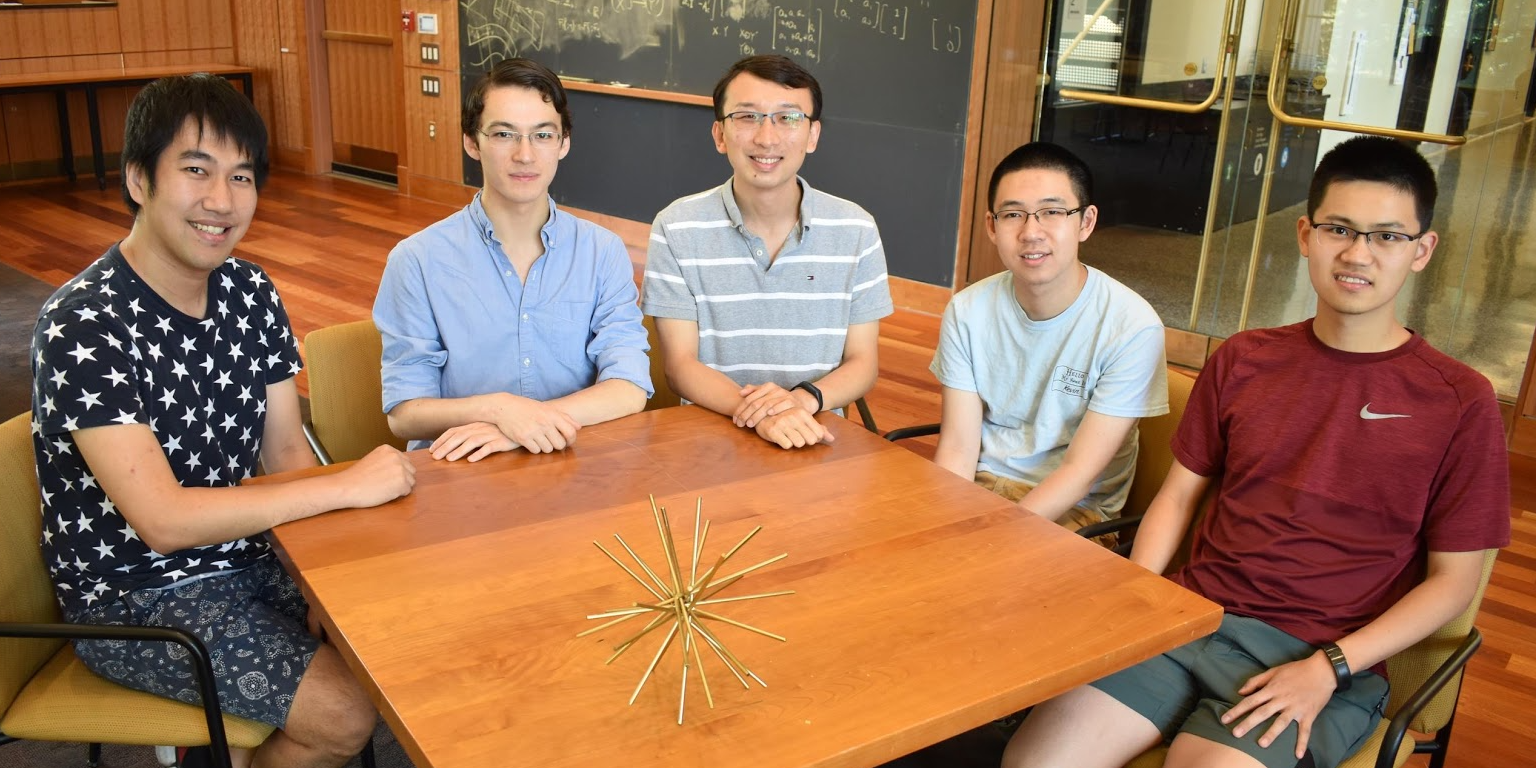
J., Tidor, Yao, Zhang, Zhao 2021 Annals of Mathematics
$E_\alpha(n) = \lfloor \frac{k}{k-1}(n-1) \rfloor$ for $n \ge n_0(\alpha)$ if $k(\lambda) < \infty$;
$E_\alpha(n) = n+o(n)$ otherwise.
J., Tidor, Yao, Zhang, Zhao 2021 Annals of Mathematics
$E_\alpha(n) = \lfloor \frac{k}{k-1}(n-1) \rfloor$ for $n \ge n_0(\alpha)$ if $k(\lambda) < \infty$;
$E_\alpha(n) = n+o(n)$ otherwise.
Spectral radius order $k(\lambda) := $ smallest $k$ such that
$\exists$ $k$-vertex graph $G$ whose adjacency matrix has spectral radius $\lambda$
- When $k < \infty$, proof needs $n \ge 2^{2^{C\lambda k}}$. Balla showed $n \ge 2^{k^{Ck}}$; Balla and Bucić showed $n \ge 2^{k^C}$ for $\alpha = 1/(2k-1)$.
- When $k = \infty$, $o(n) = O_{\alpha}(n/\log\log n)$.
Schildkraut constructed $\Omega_{\alpha}(\log\log n)$.
Connection to Spectral Graph Theory
Equiangular lines in $\mathbb{R}^n$ with angle $\arccos\alpha$
$\Leftrightarrow$ Unit vectors in $\mathbb{R}^n$ with inner product $\pm \alpha$
$\Leftarrow$$\Rightarrow$ Graph $G$, where $u \sim v$ in $G$ iff $\langle u, v\rangle = -\alpha$
s.t. $(1-\alpha) I - 2\alpha A_G + \alpha J \succeq 0$ and rank $\le n$
Equivalently, given $\alpha$ and $n$, find $G$ with max order s.t.
$(1-\alpha) I - 2\alpha A_G + \alpha J \succeq 0$ and rank $\le n$
Example when $\alpha = 1/5$, take $\lfloor (n-1)/2 \rfloor$ copies of
Upper bound on $E_\alpha(n)$
Given $\alpha$ and $n$, find $G$ with max order s.t.
$M := (1-\alpha) I - 2\alpha A_G + \alpha J \succeq 0$ and rank $\le n$
Rank-nullity
$E_\alpha(n) \le n + \mathrm{null}(M)$$\le \mathrm{null}((1-\alpha) I - 2\alpha A_G) + n + 1$
Since $M \succeq 0$, $\lambda := \frac{1-\alpha}{2\alpha}$ could be
- largest eigenvalue of $G$ (equality case)
- second largest eigenvalue of connected $G$ (need to rule out)
$\lambda := \frac{1-\alpha}{2\alpha}$ could be second largest eigenvalue of connected $G$
Switching $v$ to $-v$ in $\mathbb{R}^n$
Balla, Dräxler, Keevash, Sudakov 2018
Can switch so that max degree of $G$ $\le \Delta$
J., Tidor, Yao, Zhang, Zhao 2021
Multiplicity of second largest eigenvalue of an $n$-vertex connected graph of bounded degree is at most $Cn/\log\log n$.
Sublinear Second Eigenvalue Multiplicity
J., Tidor, Yao, Zhang, Zhao 2021
Multiplicity of second largest eigenvalue of an $n$-vertex connected graph of bounded degree is at most $Cn/\log\log n$.
Haiman, Schildkraut, Zhang, Zhao 2022: constructed second eigenvalue multiplicity $\ge C\sqrt{n/\log_2 n}$; Cayley $\ge n^{2/5}$
Proof Sketch
Multiplicity of second largest eigenvalue $\lambda$ of an $n$-vertex connected graph $G$ of bounded degree is at most $Cn/\log\log n$.
$r = c\log\log n$ and $s = c \log n$
- $H$ is $G$ with small $r$-net removed
- Radius $s$ balls in $H$ have spectral radius $\le (\lambda^{2r} - 1)^{1/2r}$
Vertex removal lowers spectral radius - Bound $\mathrm{mult}(\lambda, H)$ via moments
- $\mathrm{mult}(\lambda, G) \le \mathrm{mult}(\lambda, H) + \lvert r\text{-net} \rvert = o(n)$
by Cauchy interlacing
What is the maximum second eigenvalue multiplicity of
an $n$-vertex connected graph of bounded degree?
McKenzie, Rasmussen, Srivastava 2021
For regular graphs, $O(n/\log^c n)$
What is the maximum second eigenvalue multiplicity of
an $n$-vertex Cayley graph of bounded degree?
Gromov, Colding–Minicozzi, Kleiner
Lee–Makarychev: Constant for abelian groups
What's the maximum number $E_\alpha(n)$ of
equiangular lines in $\mathbb{R}^n$ with a fixed angle $\arccos\alpha$?
| $\alpha$ | $\lambda$ | $G$ | $k$ | $E_\alpha(n)$ |
| $\tfrac{1}{3}$ | $1$ | $2$ | $2n$ | |
| $\tfrac{1}{1+2\sqrt2}$ | $\sqrt 2$ | $3$ | $\tfrac{3n}{2}$ | |
| $\tfrac{1}{5}$ | $2$ | $3$ | $\tfrac{3n}{2}$ |
Gossett, J., Teets, Wellner 2026 for $\alpha^* = \tfrac{1}{1+2\sqrt2}$
| $n$ | 2 | 3 | 4 | 6 | 8 | 10 | 14 | 15 | 16 | 17 | 18 | 20 | 22 |
| max | 1 | 3 | 4 | 7 | 10 | 13 | 19 | 24 | 24 | 24 | 25 | 28 | 31 |
$E_{\alpha^*}(n) = \max(24, \lfloor 3(n-1)/2 \rfloor)$ for $n \ge 23$
Strongest possible sense
Classify equiangular line systems with fixed angle
$\arccos(1/(1+2\sqrt2))$ in $\mathbb{R}^n$ for all $n$,
up to orthogonal transformations
Generic construction: take vertex-disjoint union of
Classification: when $n \ge 29$, only generic equiangular line systems
For which $\alpha$, are there only finitely many non-generic equiangular line systems?
Spherical Two-distance Sets
$E_{\alpha, \beta}(n) = $ maximum number of unit vectors in $\mathbb{R}^n$
such that pairwise inner products are $\beta < 0 < \alpha$
Bukh 2005: $E_{\alpha, \beta}(n) = O_{\alpha,\beta}(n)$
Problem Determine $\lim_{n\to\infty} E_{\alpha, \beta}(n) /n$
Conjecture Depend on $k_p(\lambda)$ in terms of signed graphs
where $p = \lfloor -\alpha/\beta\rfloor+1$ and $\lambda = (1-\alpha)/(\alpha - \beta)$
Solved in special cases
- J., Tidor, Yao, Zhang, Zhao 2023: $p \le 2$ or $\lambda = 1,\sqrt{2},\sqrt{3}$
- J., Polyanskii 2025: $\lambda < \lambda^* \approx 2.0198$
$\lambda^* := \sqrt{\rho} + 1/\sqrt{\rho}$, where $\rho$ is root of $x^3 = x + 1$
Solution Framework
- Local forbidden subgraphs: leverage Gram matrix $\succeq 0$
- Global graph structure: Ramsey theory
- Equiangular lines: bounded degree graph
- Spherical two-distance sets:
complete $p$-partite XOR bounded degree
Need new insights in spectral graph theory:
- Sublinear eigenvalue multiplicity is false for signed graphs
- J., Polyanskii 2025: local forbidden subgraphs alone can never break $\lambda^*$ barrier
- J., Wang 2026: local forbidden subgraphs + global graph structure can never break $\lambda^*$ barrier as soon as $p \ge 3$
Other "Equiangular Lines"
Zauner's conjecture 1999
Maximum number of equiangular lines in $\mathbb{C}^n$ is $n^2$
Fixed angle: determine $\lim_{n\to\infty} E_\alpha^\mathbb{C}(n)/n$
Equiangular subspaces: configurations of $k$-dimensional subspaces in $\mathbb{R}^d$ with given pairwise angles
Arizona State University
[email protected]