Joint work with



- Equiangular lines in $\mathbb R^d$
- Equiangular lines with a fixed angle
- Equiangular lines with a fixed angle in high dimensions
- Classification of equiangular lines with a fixed angle
Equiangular lines in $\mathbb{R}^d$
are lines through origin
pairwise separated by the same angle
$N(d)$ = maximum number of equiangular lines in $\mathbb{R}^d$
| $d$ | 22 | 3-43-4 | 55 | 66 | 77 | 8-138-13 | 14141414 | 1515 | 16161616 | 17171717 |
| $N(d)$ | 33 | 66 | 1010 | 1616 | 2828 | 2828 | 28-3028-3028-2928-2928 | 3636 | 40-4240-4240-4140-4140 | 48-5048-5048-5048-4948 |
18181818 | 191919 | 202020 | 2121 | 2222 | 2323 | 24-4124-4124-41 | 424242 | 434343 |
48-6148-6148-6148-6157-6157-59 | 72-7672-7672-7672-7672-74 | 90-9690-9690-9690-9690-94 | 126126 | 176176 | 276276 | 276-861276-861276 | 276-903276-903276-288 | 276-946276-946344 |
- Trivial: $d=2$
- 1948 Haantjes for $d=3,4$
- 1966 van Lint–Seidel for $d=5,6,7$
- 1973 Gerzon: $N(d)\le d(d+1)/2$
1973 Lemmens–Seidel for $d=15,21,22,23$ - 2014 Barg–Yu for $d=24,\ldots,43$
2016 Greaves–Koolen–Munemasa–Szöllősi for $d=14,16$ - 2019 Greaves–Yatsyna for $d=17$
- 2021–2023 Greaves–Syatriadi–Yatsyna for $d=14$ and $16\le d\le20$
- 2024 Greaves–Syatriadi for $d=18$
What's the maximum number $N(d)$ of equiangular lines in $\mathbb{R}^d$?
1973 Gerzon
At most $\frac{1}{2}d(d+1)$
2000 de Caen
At least $cd^2$
Angles $\to$ 90° as $d\to\infty$
What happens if the angles are held fixed?
- Equiangular lines in $\mathbb R^d$
- Equiangular lines with a fixed angle
- Equiangular lines with a fixed angle in high dimensions
- Classification of equiangular lines with a fixed angle
What's the maximum number $N_\alpha(d)$ of
equiangular lines in $\mathbb{R}^d$ with a fixed angle $\arccos\alpha$?
| 1973 Neumann | $N_{\alpha}(d) \le 2d$, unless $1/\alpha$ is odd |
| 1973 Lemmens and Seidel | $N_{1/3}(d) = 2,4,6,10,16$ for $d \in \{2, \dots, 6\}$, and $\max(28, 2(d-1))$ for $d \ge 7$. |
| 1989 Neumaier | $N_{1/5}(d) = \lfloor \frac{3}{2}(d-1) \rfloor$ for $d \ge d_0$ |
| 2022 Cao, Koolen, Lin, and Yu | $N_{1/5}(d) = \max(276, \lfloor 3(d-1)/2\rfloor)$ for $d \ge 23$ |
What's the maximum number $N_{1/5}(d)$ of
equiangular lines in $\mathbb{R}^d$ with a fixed angle $\arccos(1/5)$?
| $d$ | 2 | 3 | 4 | 5 | 6 | 7 | 8 | 9 | 10 | 11 | 12 | 13 |
| $N_{1/5}(d)$ | 2 | 3 | 4 | 6 | 7 | 9 | 10 | 12 | 16 | 18 | 20 | 26 |
| 14 | 15 | 16 | 17 | 18 | 19 | 20 | 21 | 22 | 23-41 |
| 28 | 36 | 40 | 48 | 57-59 | 72-74 | 90-94 | 126 | 176 | 276 |
| $d$ | 2 | 3 | 4 | 5 | 6 | 7 | 8 | 9 | 10 | 11 | 12 | 13 |
| $N(d)$ | 3 | 6 | 6 | 10 | 16 | 28 | 28 | 28 | 28 | 28 | 28 | 28 |
| 14 | 15 | 16 | 17 | 18 | 19 | 20 | 21 | 22 | 23-41 |
| 28 | 36 | 40 | 48 | 57-59 | 72-74 | 90-94 | 126 | 176 | 276 |
What's the maximum number $N_{1/5}(d)$ of
equiangular lines in $\mathbb{R}^d$ with a fixed angle $\arccos(1/5)$?
| $d$ | 2 | 3 | 4 | 5 | 6 | 7 | 8 | 9 | 10 | 11 | 12 | 13 |
| $N_{1/5}(d)$ | 2 | 3 | 4 | 6 | 7 | 9 | 10 | 12 | 16 | 18 | 20 | 26 |
| 14 | 15 | 16 | 17 | 18 | 19 | 20 | 21 | 22 | 23-41 |
| 28 | 36 | 40 | 48 | 57-59 | 72-74 | 90-94 | 126 | 176 | 276 |
What's the maximum number $N_{1/5}(d)$ of
equiangular lines in $\mathbb{R}^d$ with a fixed angle $\arccos(1/5)$?
| $d$ | 2 | 3 | 4 | 5 | 6 | 7 | 8 | 9 | 10 | 11 | 12 | 13 |
| $N_{1/5}(d)$ | 2 | 3 | 4 | 6 | 7 | 9 | 10 | 12 | 16 | 18 | 20 | 26 |
| 14 | 15 | 16 | 17 | 18 | 19 | 20 | 21 | 22 | 23-41 |
| 28 | 36 | 40 | 48 | 57-59 | 72-74 | 90-94 | 126 | 176 | 276 |
Known results on $N(d)$ and $N_{1/5}(d)$ agree for $d \in \{14, \dots , 41\}$
1973 Lemmens–Seidel for $d \le 48$
$N(d) \le \max(N_{1/3}(d), N_{1/5}(d), \lfloor \frac{48d}{49-d}\rfloor)$
- Equiangular lines in $\mathbb R^d$
- Equiangular lines with a fixed angle
- Equiangular lines with a fixed angle in high dimensions
- Classification of equiangular lines with a fixed angle
What's the maximum number $N_\alpha(d)$ of equiangular lines
in $\mathbb{R}^d$ with a fixed angle $\arccos\alpha$ in high dimensions?
| 1989 Neumaier | $N_{1/5}(d) = \lfloor \frac{3}{2}(d-1) \rfloor$ for $d \ge d_0$ |
| 2016 Bukh | $N_{\alpha}(d) \le c_\alpha d$ |
| 2018 Balla, Dräxler, Keevash, Sudakov | $N_{\alpha}(d) \le 1.93d$ for $d \ge d_0(\alpha)$ if $\alpha \neq 1/3$ |
| 2020 J.–Polyanskii | $N_{\alpha}(d) \le 1.49d$ for $d \ge d_0(\alpha)$ if $\alpha \notin \{1/3, 1/(1+2\sqrt2), 1/5\}$ |
2016 Bukh's conjecture
$N_{1/(2k-1)}(d) \approx \frac{kd}{k-1}$
2020 J.–Polyanskii conjecture
$N_{\alpha}(d) \approx \frac{kd}{k-1}$, where $k = k(\lambda)$, $\lambda = \frac{1-\alpha}{2\alpha}$.
Spectral radius order
$k(\lambda) := $ smallest $k$ such that
$\exists$ a $k$-vertex graph $G$ whose adjacency matrix has spectral radius $\lambda$
| $\alpha$ | $\lambda$ | $G$ | $k$ | $N_\alpha(d)$ |
| $\tfrac{1}{3}$ | $1$ | $2$ | $2d$ | |
| $\tfrac{1}{1+2\sqrt2}$ | $\sqrt 2$ | $3$ | $\tfrac{3d}{2}$ | |
| $\tfrac{1}{5}$ | $2$ | $3$ | $\tfrac{3d}{2}$ | |
| $\frac{1}{7}$ | $3$ | $4$ | $\tfrac{4d}{3}$ |
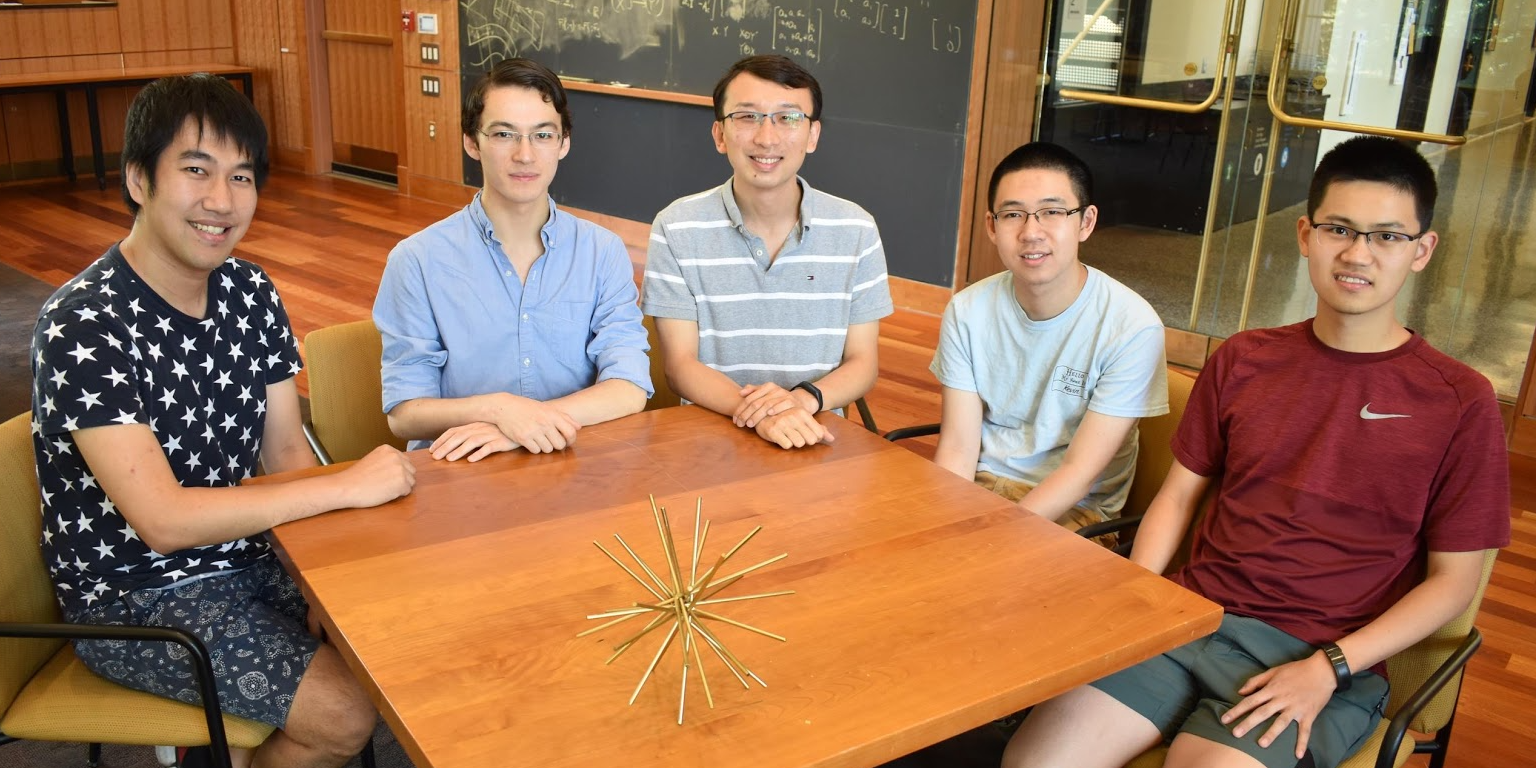
2021 J., Tidor, Yao, Zhang, Zhao
$N_\alpha(d) = \lfloor \frac{k}{k-1}(d-1) \rfloor$ for $d \ge d_0(\alpha)$ if $k(\lambda) < \infty$;
$N_\alpha(d) = d+o(d)$ otherwise.
Spectral radius order $k(\lambda) := $ smallest $k$ such that
$\exists$ a $k$-vertex graph $G$ whose adjacency matrix has spectral radius $\lambda$
- Equiangular lines in $\mathbb R^d$
- Equiangular lines with a fixed angle
- Equiangular lines with a fixed angle in high dimensions
- Classification of equiangular lines with a fixed angle
New phenomena
Generic constructions do not just win eventually
For certain angles,
exceptional constructions are bounded in order
Motivation
| $\alpha$ | $\lambda$ | $G$ | $k(\lambda)$ | $N_\alpha(d)$ | Status |
| $\tfrac{1}{3}$ | $1$ | $2$ | $\max(28,2(d-1))$ for $d\ge7$ | known for all $d$ | |
| $\tfrac{1}{1+2\sqrt2}$ | $\sqrt2$ | $3$ | $\left\lfloor 3(d-1)/2\right\rfloor$ for $d\ge d_0$ | ? | |
| $\tfrac{1}{5}$ | $2$ | $3$ | $\max\left(276,\left\lfloor 3(d-1)/2\right\rfloor\right)$ for $d\ge23$ | known for all $d$ but 18, 19, 20 |
Classification at $\alpha^*=1/(1+2\sqrt2)$
2026 Gossett, J., Teets, Wellner
| $d$ | 2 | 3 | 4 | 5 | 6 | 7 | 8 | 9 | 10 | 11 | 12 | 13 | 14 |
| $N_{\alpha^*}(d)$ | 2 | 3 | 4 | 6 | 8 | 10 | 14 | 15 | 16 | 17 | 18 | 20 | 22 |
| $N_{\alpha^*}(d)=\max\left(24,\left\lfloor 3(d-1)/2\right\rfloor\right)$ for $d\ge15$ | |||||||||||||
Classification: up to switching, there are exactly 63,673 exceptional constructions, each with at most 28 vertices
Generic constructions
take induced subgraphs and unions
take switching equivalence
Five forbidden seeds
Every graph outside $\langle P_3\rangle_\pm$ contains
up to switching, one of these five induced subgraphs
A minimal forbidden graph has at most 8 vertices
- Start from the five forbidden seeds
- Add one vertex with every possible neighborhood
- Keep $\lambda I-A_G+\frac12J\succeq0$
- Deduplicate up to switching
What we needed versus what we found
$\alpha=1/(1+2\sqrt2),\qquad \lambda=\sqrt2$
Needed for asymptotics
Bound second-eigenvalue multiplicity
$\Downarrow$
Exceptional constructions are eventually outperformed
What classification revealed
No exceptional graph has order $>28$
$\Downarrow$
Exceptional constructions are absolutely bounded
The stronger phenomenon was surprising
Open problem
Let $\mathcal G(\lambda)$ be the connected graphs with spectral radius at most $\lambda$
For which $\lambda$ are there only finitely many graphs outside
$\langle\mathcal G(\lambda)\rangle_\pm$ with $\lambda I-A_G+J/2\succeq0$?
- Yes for $\lambda=\sqrt2$: 63,673 exceptions, each with at most 28 vertices
- Yes for $\lambda=1$: 902 exceptions, each with at most 28 vertices
- No for certain $\lambda$ with $k(\lambda)=\infty$
2023 Schildkraut: $\lambda=2\sqrt{u^2+1}-1$ for any integer $u\ge10^5$
Arizona State University
[email protected]